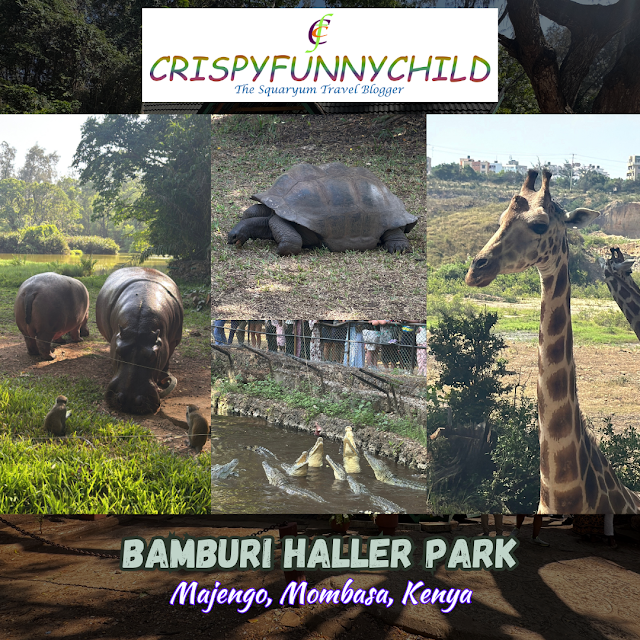
Bamburi Haller Park
Mombasa, Kenya
Majengo:
It is a ward in Mombasa, Kenya. It is divided between Kisauni & Mvita electoral constituencies.
Bamburi:
Combination of 2 local Bantu words (Ba means people & mburi means goat). It is a commercial, industrial, local electoral, administrative, tourist & residential area on the coast-line of Kenya along the Indian Ocean. It is famous for Haller Park.
Haller Park:
Also called Bamburi Haller Park.
Felix Mandl was a Croatian businessman and entrepreneur, who founded Bamburi Cement in Kenya, in 1951.
Born: 16th December, 1898
Died: 1993
He was born to a wealthy Jewish family.
The cement factory was situated around 12km north of Mombasa. Over the years, cement production grew from around 1.2 million tons to around 25 million tons. This resulted in the formation of inhospitable arid wasteland with brackish water. It was even impossible to grow any plants there. So, Bamburi Cement company, deciding to rehabitate the quarries, appointed Rene Haller as the manager of the garden department, in 1959.
At first, after planting around 26 plants, only 3 survived:
- Damas (Arabic name for Qalab in Somali) [Conocarpus lancifolius]
- Coconut Palm
- Casuarina (She-Oak or Australian Pine) [Casuarina equisetifolia]
Haller also introduced hundreds of red legged millipede, whose droppings (while feeding on the casuarina needles) made it easy to break down bacteria, resulting in the formation of rich layer of humus, allowing other plant species to grow. Slowly-slowly plants, shrubs & trees started to grow. Some for 10 years, 20 years, 30 years or more. Along with this, many animals also started to come. Some were brought here for safe living and protection from getting extinct.
Thus, Haller Park got developed, near the cement factory, becoming one of the famous tourist spot in Mombasa, Kenya. And it was named as Haller Park to remember the hard work doe by Rene Haller behind the development of this park.
Giraffe:
Tallest living terrestrial animal
- Vertibrate
- Mammal
- class: Mammalia
- order: Artiodactyla
- family: Giraffidae
- sub-family: Giraffinae
- genus: Giraffa
- food habit: Herbivores (generally feeds on Acacia [Babla in Bengali])
Monkey:
Identified by long tail, agility & tree-dwelling nature
- Vertibrate
- Mammal
- class: Mammalia
- order: Primates
- food habit: Omnivores
Monkeys are divided into:
- Old World Monkeys
- New World Monkeys
Old World Monkeys:
- family: Cercopithecidae
- sub-family: Cercopithecinae & Colobinae
New World Monkeys:
- family: Atelidae, Cebidae, Aotidae, Pitheciidae & Callitrichidae
Monitor Lizards:
Lizards native to Africa, Asia & Oceania
- Vertibrate
- Reptiles
- class: Reptilia
- order: Squamata
- sub-order: Anguimorpha
- family: Varanidae
- genus: Varanus
- food habit: Carnivores
Tortoise:
Terrestrial animal with a dome-like shell on the back for protection against threats
- Vertibrate
- Reptile
- class: Reptilia
- order: Testudines
- family: Testudinidae
- sub-family: Testudinoidea
- food habit: Herbivores
Difference Between Tortoise & Turtles
| Tortoise | Turtles |
| Lives in dry lands | Generally lives in water (swimming or wading) |
| Heavy, high, rounded and dome-shaped shells | Flatter, thinner and more streamlined shells |
| Heavy, sturdy, elephant-like legs with clawed, club-like feet | Webbed feet or flippers |
| Mostly herbivores | Mostly omnivores |
| Lifespan of around 80 years to 150 years | Lifespan of around 20 years to 40 years |
Crocodile:
Large and semi-aquatic reptiles
- Vertibrate
- Reptiles
- class: Reptilia
- order: Crocodilia
- family: Crocodylidae
- sub-family: Crocodyloidea
- genus: Crocodylus
- food habit: Carnivores
Hippopotamus:
Third largest terrestrial mammal
- Vertibrate
- Mammals
- class: Mammalia
- order: Artiodactyla
- family: Hippopotamidae
- genus: Hippopotamus
- scientific name: Hippopotamus amphibius
- food habit: Herbivores
Cat:
Small domesticated terrestrial mammal
- Vertibrate
- Mammals
- class: Mammalia
- order: Carnivora
- family: Felidae
- genus: Felis
- scientific name: Felis catus
- food habit: Carnivores